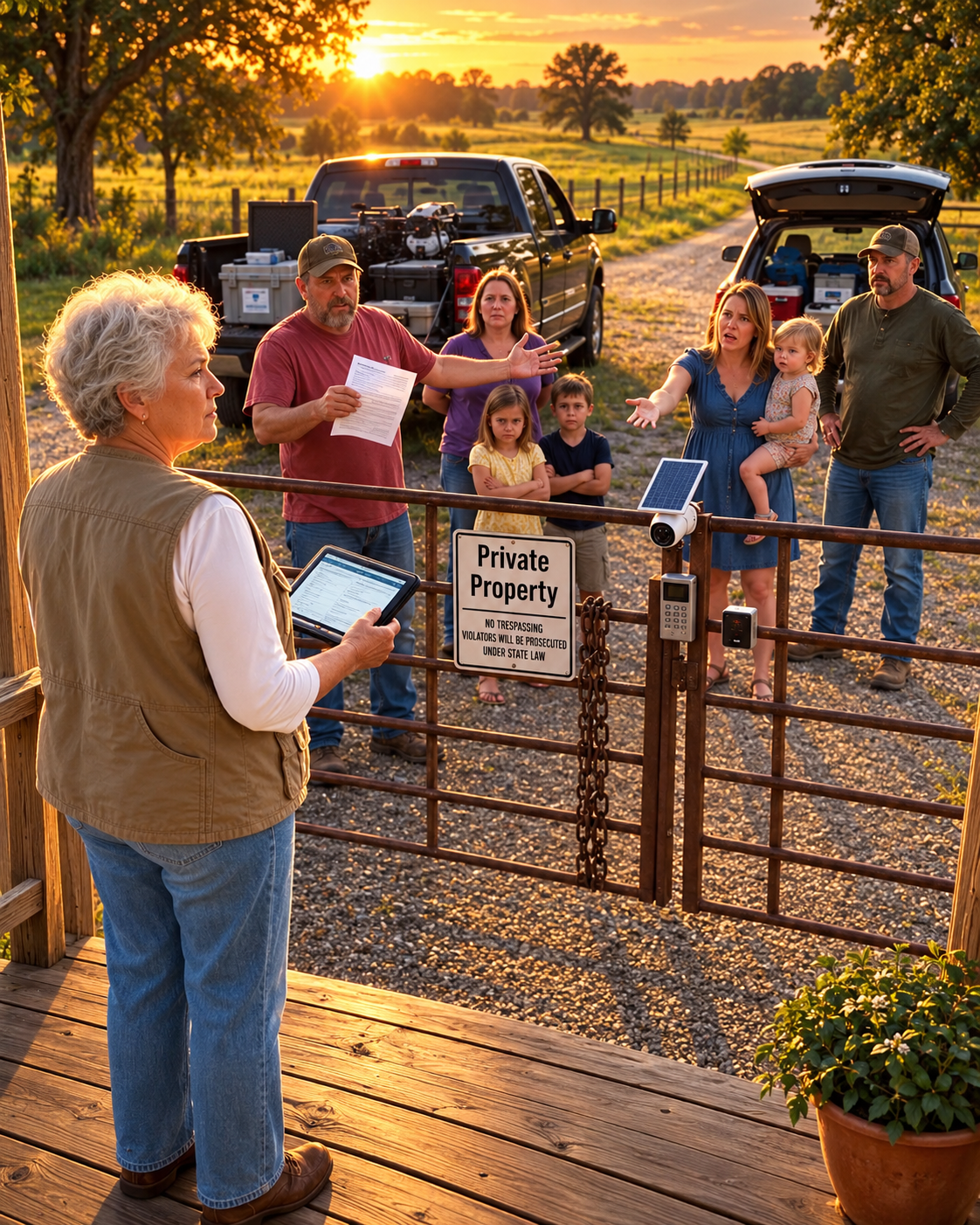
I thought there would be anger.
Maybe satisfaction.
Maybe some grand feeling of revenge.
Instead, I felt tired.
Deeply tired.
The kind of tired that comes when you finally put down something heavy you didn’t realize you’d been carrying for years.
Daniel looked toward the notebook again.
“Mom,” he said, quieter this time, “why did you write all this down?”
I folded my arms.
“You tell me.”
He looked at me as though I had asked him a question he wasn’t prepared to answer.
Melissa walked toward the plastic box.
“Can I?”
I nodded.
She opened it.
The notebook was thick now.
Its black cover had faded at the corners. The elastic band that once held it closed had been replaced with a piece of twine.
She opened to the first page.
The handwriting was mine.
Small.
Neat.
Careful.
At the top was a date.
June 14, 2009.
Underneath, I had written:
Daniel and Melissa — weekend.
Then:
Arrived Friday.
Six adults. Three children.
Used downstairs bedroom.
Two gallons of milk.
One propane tank.
Borrowed pressure washer.
Said they would replace propane.
Melissa swallowed.
She turned the page.
There were more dates.
More weekends.
More names.
More promises.
Some were harmless.
A borrowed ladder.
A missing rake.
A broken folding chair.
A box of fishing equipment.
Then the numbers began getting larger.
Feed.
Fuel.
Repairs.
Electricity.
Cleaning.
Groceries.
Plumbing.
Roofing.
Fencing.
The notebook wasn’t really a diary.
It was a record.
A record of every little thing that had been dismissed as insignificant.
Helen shook her head.
“Ruth, you actually kept track of grocery money?”
“I kept track of everything.”
“Why?”
I looked at her.
“Because nobody else did.”
That sentence seemed to hit harder than anything else.
Helen closed her mouth.
Daniel looked down.
I could hear a chicken scratching near the porch steps.
One of them clucked softly, completely uninterested in the family drama unfolding at the gate.
I almost smiled.
Almost.
Then Daniel said something I hadn’t expected.
“Mom, you never told us you were struggling.”
I stared at him.
“You never asked.”
He opened his mouth.
Nothing came out.
I turned toward the kitchen.
“You should all go home.”
His face tightened.
“But we drove three hours.”
“I know.”
“We’ve got the kids.”
“I know.”
“We thought—”
“That’s the problem.”
I stopped at the doorway.
“You thought.”
Nobody answered.
“You thought there would be beds.”
I pointed toward the trucks.
“You thought there would be food.”
Then toward the barn.
“You thought you could use the equipment.”
Finally, I pointed at the flowerpot.
“And you thought the key would be there.”
Daniel looked ashamed.
But shame didn’t make me feel better.
I had spent too many years accepting apologies that changed nothing.
So I said the one thing I had never said before.
“You never thought about me.”
The silence afterward was enormous.
Then Helen stepped forward.
“Ruth…”
I looked at her.
She was crying.
Not dramatically.
Just quietly.
“I didn’t know.”
I nodded.
“I know.”
“I honestly didn’t know.”
“I know.”
She wiped her cheek.
“Why didn’t you tell us?”
I looked past her toward the barn.
Because the truth was complicated.
Because I had been proud.
Because I had wanted my family to have a place where they felt welcome.
Because my husband had always said a house was supposed to have an open door.
And because somewhere along the way, I had confused being needed with being loved.
I didn’t say any of that.
Instead, I said:
“Go home, Helen.”
She nodded.
One by one, people began putting their bags back into the vehicles.
No one complained.
No one slammed a door.
No one called me selfish.
That almost made it worse.
Daniel was the last one standing.
He looked at the notebook.
Then at me.
“Can I ask you something?”
“What?”
“How long have you been planning this?”
I felt something cold move through me.
“Planning what?”
“The sign.”
I looked at him.
“The notebook.”
His voice dropped.
“The locked gate.”
I didn’t answer immediately.
Because there was something he didn’t know.
Something nobody there knew.
The sign had only been made three days earlier.
The gate had only been locked that morning.
But the notebook?
The notebook had been waiting for years.
I looked at Daniel and said:
“I didn’t plan this.”
His eyebrows pulled together.
“Then what happened?”
I glanced toward the pasture.
The sun was beginning to disappear behind the tree line.
“I got tired.”
He nodded slowly.
Then he said:
“Is that all?”
I looked at him.
For a moment, I thought about telling him everything.
But not yet.
Because there was another reason I had started writing things down.
And it had nothing to do with potato salad.
I waited until everyone had left.
The last taillights disappeared beyond the hill.
Then I locked the main gate again.
I walked back to the porch.
My boots sounded against the wooden steps.
Inside the kitchen, I turned on the small lamp above the sink.
The farm became quiet.
Really quiet.
The kind of quiet I had forgotten existed.
I made myself a cup of tea.
Then I sat at the kitchen table and opened the notebook.
I turned past the pages Daniel had seen.
Past the grocery lists.
Past the repair expenses.
Past the names.
Toward the back.
There were several pages I had never shown anyone.
They were written in a different ink.
Red ink.
The first page was dated eleven years earlier.
I ran my finger across the words.
October 3, 2015.
Then beneath it:
Something is wrong with the property records.
I closed my eyes.
That was the real reason the notebook had started.
Not because of the family.
Not because of the weekends.
Not even because of Daniel.
It had started with my husband.
His death had been ruled an accident.
A tractor accident.
Everyone accepted that.
Everyone except me.
Because three days before he died, he had come into this kitchen carrying a folder.
He had looked frightened.
My husband had never been easily frightened.
He put the folder on the table.
Then he told me something I didn’t understand.
He said:
“Ruth, if anything happens to me, don’t let them sell the farm.”
I had laughed.
I thought he was talking about the bank.
I thought he was worried about the mortgage.
I told him we had insurance.
He shook his head.
“No.”
He looked toward the window.
“Not the bank.”
“Then who?”
He never answered.
That night, he locked the folder in the old filing cabinet in the barn.
Three days later, he was dead.
And the folder disappeared.
For eleven years, I had searched for it.
I had searched through boxes.
Drawers.
Old tax records.
Insurance papers.
Tool cabinets.
Even the attic.
Nothing.
Until six months ago.
I found something behind the loose boards underneath the stairs in the barn.
A small metal key.
Wrapped in an envelope.
My name was written on it.
Ruth.
No last name.
No explanation.
Just my name.
I hadn’t told anyone.
Not Daniel.
Not Helen.
Nobody.
Because the key didn’t fit any lock in the house.
It didn’t fit the barn.
It didn’t fit the machinery shed.
It didn’t fit the old safe.
But last month, while cleaning out my husband’s workbench, I discovered something I had never noticed before.
A tiny brass plate underneath the bottom drawer.
And engraved into it were four numbers.
The same four numbers written on the key.
I hadn’t opened it yet.
I was afraid.
Not of what might be inside.
Of what might happen if I found the truth.
Tonight, after my family had driven away, I finally decided I was ready.
I went outside.
The moon was rising over the pasture.
I walked toward the barn with a flashlight in one hand and the little brass key in the other.
The old building creaked in the wind.
I unlocked the side door.
Inside, everything smelled like dust, hay, and old wood.
I crossed the barn.
Passed the tractor.
Passed the shelves of tools.
Then I stopped at my husband’s workbench.
My hands trembled as I pulled open the bottom drawer.
The brass plate was still there.
Four numbers.
I inserted the key.
It turned.
Something clicked.
The entire back panel of the workbench moved.
Just an inch.
I froze.
Then I pulled it.
Behind the panel was a narrow wooden compartment.
And inside was a sealed envelope.
But there was something else.
A photograph.
I picked it up.
My heart stopped.
It was a picture of my husband standing beside the barn.
But he wasn’t alone.
Standing beside him was Daniel.
My son.
Only seventeen years old.
And behind them was a third man I didn’t recognize.
I turned the photograph over.
Written on the back, in my husband’s handwriting, were six words:
“If Ruth ever finds this, ask Daniel.”
I dropped the photograph.
For the first time that night, I wasn’t thinking about the locked gate.
Or the family.
Or the group chat.
I was thinking about my son.
And the question my husband had left me eleven years ago.
What had Daniel known?
And why had my husband been afraid of him?
Part 3 — The Truth Behind the Farm
I didn’t sleep that night.
The photograph lay on the kitchen table.
I had turned it face down.
Then face up.
Then face down again.
Every time I looked at it, I saw the same three people.
My husband.
My son.
And a stranger.
Daniel had been seventeen.
Young enough to make mistakes.
Old enough to know right from wrong.
And according to my husband’s handwriting, he knew something.
By sunrise, I had made a decision.
I was going to ask him.
Not over the phone.
Not by text.
To his face.
At nine in the morning, I called him.
“Daniel?”
“Mom?”
“I need you to come to the farm.”
There was a pause.
“Is everything okay?”
“No.”
His breathing changed.
“I’ll come.”
Two hours later, his truck appeared at the end of the road.
This time, he stopped outside the gate.
He didn’t reach for the flowerpot.
He didn’t assume anything.
He got out and waited.
I walked toward him.
For a moment, neither of us spoke.
Then I held up the photograph.
Daniel’s face went completely white.
I didn’t miss it.
“You know him.”
He looked down.
“Yes.”
“Who is he?”
Daniel swallowed.
“His name was Robert Vale.”
The name meant nothing to me.
“Why was he standing with your father?”
Daniel rubbed his hands over his face.
“Mom, there’s something I should have told you a long time ago.”
“Yes.”
He looked at the photograph.
Then at the barn.
“Your father found out someone was trying to take the farm.”
My heart tightened.
“Who?”
“Robert.”
“Why?”
“Because the land around us was becoming valuable.”
I stared at him.
Daniel continued.
“He was buying properties from older farmers. Quietly. Through shell companies. He wanted enough land to build something.”
“What?”
“A private development. Vacation homes. A resort. Something like that.”
I thought about all the years people had called my farm a little escape.
It seemed almost cruel now.
“Your father refused to sell.”
Daniel nodded.
“He told Robert no.”
“Then why were you with him?”
Daniel looked ashamed.
“Because Robert approached me.”
I felt the ground beneath me disappear.
“What did he want?”
“Information.”
“What information?”
“Your father’s financial problems. The mortgage. The property taxes. Whether he’d ever consider selling.”
I stared at my son.
“And you told him?”
Daniel closed his eyes.
“Some things.”
My voice became very quiet.
“How much?”
“I don’t remember.”
“Daniel.”
He looked at me.
“Enough.”
That one word hurt more than an admission of everything.
I stepped backward.
“So your father knew.”
“Yes.”
“And that’s why he wrote this?”
I held up the photograph.
Daniel nodded.
“He found out.”
“What happened?”
Daniel looked toward the barn.
“The night before Dad died, he confronted me.”
My hands went cold.
“He knew I’d spoken to Robert.”
“What did he say?”
“He said I had no idea what I was risking.”
I waited.
“Then he told me he’d found documents proving Robert had been trying to manipulate the farm’s debts.”
“Where were those documents?”
“The folder.”
“The folder that disappeared.”
Daniel didn’t answer.
I already knew.
“You took it.”
He shook his head.
“No.”
“Then who did?”
“I don’t know.”
I stared at him.
For eleven years, that question had lived inside me.
Now the answer was finally within reach.
“What happened the day your father died?”
Daniel’s eyes filled with tears.
“I argued with him.”
“About the farm?”
“Yes.”
“What happened after?”
“I left.”
“And he went to the barn.”
“Yes.”
“Then?”
“I got a call later.”
“From who?”
“Robert.”
My stomach turned.
“What did he say?”
Daniel’s voice broke.
“He said Dad had been in an accident.”
I stared at my son.
“How did Robert know?”
Daniel didn’t answer.
He didn’t have to.
For several seconds, we stood there in silence.
Then I asked the question that had haunted me for eleven years.
“Did Robert kill your father?”
Daniel looked at me.
“I don’t know.”
It was the most honest answer he’d given me.
And somehow, that mattered.
I went into the barn.
Daniel followed.
We stood beside the old workbench.
I showed him the hidden compartment.
His eyes widened.
“You found it.”
“I found what your father wanted me to find.”
Inside the compartment was the sealed envelope.
I opened it.
There were copies of property documents.
Bank statements.
Letters.
And photographs.
Enough evidence to show that Robert had been trying to pressure several local landowners into selling.
But there was one final document.
A handwritten statement from my husband.
I read it slowly.
He had written that if anything happened to him, I should take the documents to an attorney.
He had also written one final sentence.
“Daniel made a mistake, but he isn’t the person I’m afraid of.”
I stopped reading.
Daniel saw the sentence.
His shoulders collapsed.
“I thought Dad hated me.”
“He didn’t.”
“I thought he blamed me.”
“He didn’t.”
“Then why didn’t you tell me?”
I looked at him.
“Because you didn’t tell me.”
His eyes filled with tears.
“I was ashamed.”
“I know.”
“I wanted to fix it.”
“You can’t fix eleven years.”
“I know.”
For a long time, neither of us moved.
Then Daniel whispered:
“I’m sorry, Mom.”
I looked at my son.
Not the seventeen-year-old boy in the photograph.
Not the man who had removed me from a group chat.
Just my son.
The child who had once fallen asleep against my shoulder in the farmhouse kitchen.
The teenager who had helped his father repair the fence.
The adult who had forgotten how much his mother had sacrificed.
“I forgive you,” I said.
His face crumpled.
“But forgiveness doesn’t mean everything goes back to the way it was.”
He nodded.
“I know.”
“You don’t get a key.”
“I know.”
“You don’t get to arrive without asking.”
“I know.”
“You don’t get to decide whether I belong in your life.”
He looked at me.
“No, Mom.”
I took a breath.
“That decision belongs to me now.”
Three weeks later, Daniel helped me take the documents to an attorney.
The investigation reopened old questions surrounding my husband’s death.
Robert Vale had disappeared years earlier.
But the property records led investigators to several companies connected to him.
The farm wasn’t lost.
The debt wasn’t what we had believed.
And, most importantly, my husband had left enough evidence behind to protect the land.
The little farm notebook became evidence too.
Eleven years of dates.
Names.
Conversations.
Promises.
Every forgotten detail suddenly mattered.
The notebook my family had mocked became the thing that helped establish a pattern of what had happened around the farm.
I never imagined that would happen.
I had simply been writing things down.
Because writing things down was how I remembered.
And remembering, I learned, can be its own kind of protection.
A month later, I replaced the old sign.
The new one was smaller.
Simpler.
It said:
RUTH’S FARM
PRIVATE PROPERTY
PLEASE ASK BEFORE ENTERING.
That was all.
No anger.
No explanation.
No apology.
I didn’t need one.
Labor Day came and went.
The farm was quiet.
The porch swing moved gently in the evening breeze.
The chickens wandered through the grass.
The barn stood red against the fading sky.
And for the first time in years, I sat on my porch without wondering who was coming through the gate next.
A week later, I heard a knock.
It was Daniel.
He stood outside the gate holding a small cardboard box.
He didn’t come in.
“Mom?”
I walked over.
“What is it?”
He held out the box.
“I found this in Dad’s things.”
I opened it.
Inside was a little wooden sign.
My husband’s handwriting was burned into the wood.
It said:
HOME IS NOT A PLACE YOU ARE ALLOWED TO USE.
I stared at it.
Daniel wiped his eyes.
“I think Dad made it years ago.”
I ran my fingers over the letters.
Then I looked at my son.
“Do you want to come in?”
He smiled sadly.
“If you’re sure.”
I opened the gate.
Not because he was entitled to enter.
Not because he was family.
Not because he expected me to.
Because I invited him.
We walked toward the house together.
At the porch, Daniel stopped.
“Mom?”
“Yes?”
“I’m glad you locked the gate.”
I looked at him.
“So am I.”
He smiled.
And that was the strange thing.
The locked gate hadn’t ended my family.
It had finally taught us what family was supposed to mean.
Love could have an open heart.
But it could still have a locked gate.
And sometimes the strongest thing a mother can say isn’t “come in.”
It’s:
“Ask first.”
That evening, I opened my old black notebook one last time.
On the final page, I wrote:
September 7.
The gate is locked.
The farm is safe.
My husband kept his promise.
Then I paused.
Underneath, I added one final sentence.
And for the first time, I think I kept mine.
I closed the notebook.
Outside, the porch light glowed against the dark.
The chickens settled beneath the coop.
The pasture disappeared into the night.
And the farm was quiet.
Not lonely.
Quiet.
There is a difference.
For years, I had thought being loved meant being useful.
I thought if I cooked enough meals, opened enough doors, washed enough sheets, and forgave enough disappointments, my family would understand what I meant to them.
I was wrong.
People don’t always value what you give them.
Sometimes they only value it after you stop giving it.
And sometimes, when you finally stop making yourself smaller so everyone else can be comfortable, you don’t lose your place in the family.
You find your place in your own life.
I looked toward the locked gate.
Then I smiled.
Because the key wasn’t under the flowerpot anymore.
It was in my pocket.
And this time, I knew exactly who was allowed to have it.
