Elena had heard alarms inside rescue barns before.
Some meant a temperature had fallen too low.
Some meant an IV line had become blocked.
Some meant an animal had moved unexpectedly and triggered a sensor.
But there was something about the sound that tore through the quiet barn at two in the morning that made her body react before her mind could catch up.
She was already running before she fully understood why.
Her shoes slapped against the concrete aisle as she rushed past darkened stalls.
Behind several gates, rescued horses lifted their heads.
A goat bleated once from the far end of the building.
Then Elena reached the small recovery stall where the young donkey had been placed only a few hours earlier.
She stopped so suddenly that another volunteer nearly crashed into her.
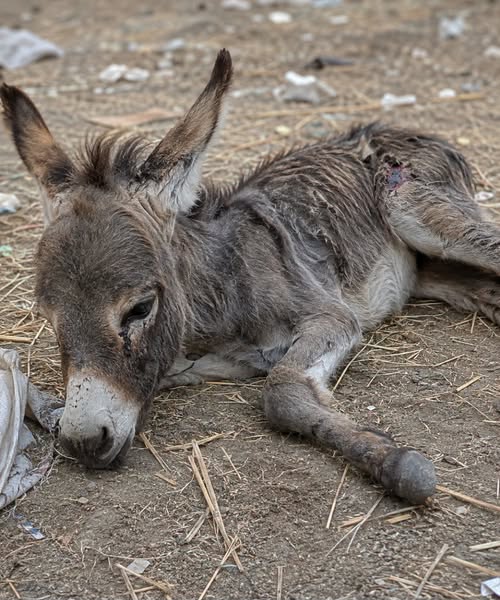
The foal was lying on his side.
Completely still.
His mother stood behind the divider, pacing back and forth.
Every few seconds she pushed her nose through the gap, trying to reach him.
“Elena, move.”
Dr. Mara Lewis hurried into the stall carrying a medical bag.
Elena stepped aside.
The veterinarian dropped to her knees beside the foal and placed two fingers against the inside of his front leg.
No one spoke.
Elena stared at the little animal’s ribs.
Earlier that evening she had been able to see them rise and fall, slowly but clearly.
Now she couldn’t tell if they were moving at all.
“Mara?”
“Quiet.”
The veterinarian lowered her ear near the foal’s nose.
Then she placed a hand against his chest.
One second passed.
Two.
Three.
Elena felt the room narrowing around her.
Finally Mara said, “He’s breathing.”
Elena closed her eyes.
The volunteer behind her released a shaky breath.
But Mara didn’t relax.
“Barely.”
She opened her bag.
“We need the warming blankets. Now.”
Elena turned.
“His temperature?”
“Dropping.”
Another volunteer ran toward the supply room.
Mara checked the foal’s gums again.
They were still far too pale.
His dehydration had been severe when they found him, but dehydration wasn’t the only problem.
He had been without enough nutrition for far too long.
His young body had used almost everything it had simply to survive the heat, the hunger, and the hours spent waiting in that field.
When an animal became that weak, rescue was not as simple as offering food and expecting strength to return.
Too much food too quickly could create new problems.
Too much movement could exhaust him.
Even stress could become dangerous.
Everything had to be done slowly.
Carefully.
One decision at a time.
The warming blankets arrived.
Elena helped slide one beneath the foal while Mara wrapped another around his body.
His mother let out a low, distressed call.
The sound seemed to fill the entire barn.
The foal’s ear twitched.
Elena froze.
“Did you see that?”
Mara nodded.
“Let her talk to him.”
The mother moved closer to the divider.
She stretched her neck as far as she could and called again.
The foal’s ear moved a second time.
It was almost nothing.
But that tiny response felt enormous.
Elena sat on the floor near his head.
“You hear her, don’t you?”
She spoke softly.
“She’s right here.”
The foal didn’t open his eyes.
His mother kept her nose pressed against the bars.
For the next hour, the rescue team worked quietly.
Fluids continued.
His body was warmed.
His breathing was watched constantly.
Every few minutes Mara checked his heart rate.
Nobody wanted to say what all of them were thinking.
They had found him.
They had found his mother.
They had reunited them.
It felt impossible that the story could still end here.
At 3:17 a.m., the foal opened one eye.
Elena almost laughed from relief.
“Hey.”
His eye closed again.
But a few seconds later, his nose shifted toward her hand.
She didn’t touch him immediately.
Instead, she let him smell her.
He moved his muzzle less than an inch.
Mara noticed.
“Good.”
“Good?”
“It’s something.”
For the first time since the alarm sounded, Mara’s voice carried a little hope.
The mother remained standing.
She had been offered hay and water, but she barely touched either.
Her injured leg had been cleaned and wrapped.
The wire had cut into the skin, but fortunately it had not damaged the bone.
She needed rest.
Instead, she stood beside the divider and watched her baby.
Elena eventually brought a bucket of water closer to her.
The mother drank without taking her eyes off the foal.
“You two really weren’t giving up on each other, were you?”
Elena whispered.
She kept thinking about the field.
About the way the little donkey had repeatedly turned his ears toward the same place.
At first everyone had assumed he was simply reacting to distant noise.
Now she understood.
He had known.
Maybe he hadn’t known exactly where his mother was.
Maybe he hadn’t understood why she wasn’t coming.
But somewhere beyond that broken fencing, he had heard enough to know she was still there.
And she had heard him too.
They had spent hours separated by only a few hundred feet.
Each one unable to reach the other.
The thought made Elena’s chest ache.
At four in the morning, Mara finally sat against the wall.
“He’s stabilizing.”
Elena looked at her.
“Really?”
“For now.”
Those two words mattered.
For now.
Rescue work had taught Elena never to celebrate too early.
Animals sometimes rallied before declining.
They sometimes looked stronger because adrenaline temporarily hid how exhausted they truly were.
The next twelve hours would matter.
Maybe the next twenty-four.
But at least the foal had made it through the first crisis.
Elena rested her head against the wall.
She intended to close her eyes for only a minute.
She woke forty minutes later to a strange scraping sound.
At first she thought someone was cleaning a stall.
Then she heard it again.
Scratch.
Pause.
Scratch.
She opened her eyes.
The foal was moving.
One of his front legs had shifted beneath him.
Elena immediately sat up.
“Mara.”
The veterinarian woke from the chair across the aisle.
“What?”
“He’s trying something.”
The foal moved his other front leg.
His head lifted.
It trembled badly.
Then he lowered it.
His mother made a soft sound.
The baby lifted his head again.
Elena put one hand over her mouth.
“He’s trying to get up.”
Mara approached but didn’t enter the stall immediately.
“Don’t help him unless he gets into trouble.”
Elena looked at her.
“Why?”
“He needs to control the effort himself.”
The foal gathered his front legs under his chest.
For several seconds nothing happened.
Then he pushed.
His shoulders lifted.
His back legs remained flat.
He held himself halfway upright.
Then collapsed gently into the bedding.
His mother called.
The little donkey’s eyes opened wider.
He rested.
One minute.
Two.
Then he tried again.
This time his front legs straightened.
His body shook violently.
He attempted to bring one back leg underneath himself.
It slipped.
He fell again.
Elena instinctively stepped forward.
Mara held out an arm.
“Give him a moment.”
The baby remained lying down.
His breathing quickened.
For a while Elena thought the effort had exhausted him.
Then sunlight began to appear through the barn windows.
A thin orange line stretched across the floor.
The foal’s mother lowered her head through the divider and touched his neck.
The baby turned toward her.
Slowly, unbelievably, he tried for a third time.
Front legs first.
Then one back leg.
Then the other.
His knees shook.
His entire body swayed.
But he was standing.
Elena stopped breathing.
“Look at him.”
Mara smiled.
“Easy, little guy.”
One second.
Two.
Three.
The foal’s legs trembled so badly Elena was certain he would fall.
Instead, he took a step.
It was awkward.
Barely half the length of his hoof.
But it was a step.
His mother called.
He took another.
Then another.
On the fourth step he leaned sideways.
Elena moved closer, ready to support him if necessary.
But he corrected himself.
Five steps.
Six.
And then he reached the divider.
His mother stretched her neck toward him.
Their noses touched.
The foal closed his eyes.
His mother began gently moving her lips through the fur along his forehead.
Grooming him.
Elena heard someone crying behind her.
She turned.
One of the volunteers who had helped cut the wire from the mother’s leg was standing in the aisle wiping his face with both hands.
“I’m fine,” he said.
Nobody believed him.
Nobody cared.
Elena’s own eyes were wet.
The little donkey stood for less than a minute before his legs began to weaken.
This time Mara stepped in.
She guided him gently back onto the bedding.
“That’s enough.”
The foal settled down.
His mother remained beside him.
For the first time all night, she began eating.
Mara looked toward Elena.
“That’s a very good sign.”
“What is?”
“Mom relaxing enough to eat.”
Elena looked back at the pair.
Maybe the mother understood something had changed too.
Maybe she could sense that her baby was no longer slipping away.
The next morning, they finally gave the two donkeys names.
Rescue organizations often waited before naming animals, especially when ownership or history was unclear.
But one of the volunteers suggested they needed something better than “the mother” and “the foal.”
Someone proposed Daisy for the mother.
Someone else suggested Hope.
Elena shook her head.
“She doesn’t look like a Daisy.”
“What does she look like?”
Elena watched the donkey standing protectively beside her baby.
“Willow.”
Mara smiled.
“Why Willow?”
“Because she bent without breaking.”
The name stayed.
The foal took longer.
Several ideas were offered.
Dusty, because they had found him almost hidden in the dirt.
Lucky, because he had survived.
Scout, because he had kept listening toward the fence.
But Elena looked at him and said, “Echo.”
Everyone turned.
“Echo?”
“He kept calling for her. She kept calling for him.”
Elena smiled.
“And somehow they found each other.”
So the mother became Willow.
And the baby became Echo.
For the next three days, Echo’s world remained small.
A padded stall.
Fresh bedding.
Water.
Carefully measured food.
Veterinary checks.
And Willow.
Always Willow.
At first, Echo spent most of the day lying down.
But every time Willow moved, his ears followed her.
If she stepped toward the water bucket, he watched.
If she shifted to another side of the stall, his head turned.
If she disappeared behind the partition even for a moment, he called.
The sound was weak at first.
Then stronger.
By the fourth day, everyone in the barn knew when Willow moved somewhere Echo couldn’t see.
His voice made sure of that.
“You’ve got some opinions now,” Elena told him.
Echo stared at her.
His ears moved forward.
“You were a lot quieter when we met.”
He took two steps toward her.
Then changed his mind and returned to Willow.
Elena laughed.
“That’s fair.”
His appetite improved slowly.
His body had been deprived for too long, so the veterinary team followed a careful feeding schedule.
Small amounts.
Frequent monitoring.
Plenty of hydration.
They watched for signs of digestive problems.
They tracked his weight.
They checked his temperature.
Every improvement mattered.
One pound gained.
A stronger heartbeat.
More interest in his surroundings.
A longer period standing.
A small attempt to nibble hay.
None of those moments would have seemed dramatic to someone who had never watched a fragile animal recover.
But inside the rescue center, they felt like victories.
On the seventh day, Echo did something unexpected.
Elena entered with a fresh bucket of water.
Echo was standing beside Willow.
When he saw Elena, he took three quick steps forward.
Then another.
His legs still looked slightly unsteady.
But there was energy in them now.
Elena stopped.
“Are you coming to see me?”
Echo approached the bucket.
“Oh.”
She laughed.
“You wanted the water.”
He drank.
Then nudged her arm.
Elena looked at him.
“You absolutely did that on purpose.”
He nudged her again.
From the doorway, Mara said, “I think you’ve been promoted.”
“To what?”
“Bucket servant.”
Echo pushed his nose against Elena’s sleeve.
She scratched gently along the side of his neck.
For the first time, he didn’t pull away.
That afternoon, the rescue center posted a short update about Willow and Echo.
They avoided showing the most upsetting images from the field.
Instead, they shared a photograph of Echo standing beside his mother.
Within hours, messages arrived from people around the region.
Some wanted to donate.
Some asked whether the animals would eventually be adopted.
Others simply wanted to know if Echo was going to survive.
Elena read some of the comments aloud inside the barn.
“Someone says you’re handsome.”
Echo chewed hay.
“Someone else says Willow deserves unlimited carrots.”
Willow lifted her head.
Elena laughed.
“She heard that one.”
But among the messages came questions that the rescue team couldn’t yet answer.
How had the two donkeys ended up abandoned in the field?
Who owned the property?
How long had they been there?
Had someone known Willow was trapped?
Had someone intentionally left them?
The field where they had been found was part of a larger neglected property on the edge of the county.
Records showed that it had changed hands several times.
The current owner lived in another state.
A local caretaker had apparently been responsible for checking the land.
When officials contacted him, he claimed he had not known any donkeys were there.
That explanation raised even more questions.
There had been broken buckets near the fence.
Old hoof prints.
A damaged shelter.
The animals had clearly not wandered onto the property that same afternoon.
Someone had fed them at some point.
Someone had used the enclosure.
But whoever that person was, they had stopped coming.
Animal control opened an investigation.
Elena tried not to think about it while caring for Echo.
She had learned that anger could consume the energy rescuers needed for the animals in front of them.
There would be time for questions.
Right now, Echo needed strength.
Willow needed her leg to heal.
And both needed to learn that food and water would continue appearing tomorrow.
And the day after that.
And the day after that.
Animals who had experienced neglect often behaved differently around resources.
Some ate too quickly.
Some guarded food.
Some became frantic when a bucket was removed.
Willow did none of those things.
Instead, she always allowed Echo to approach first.
If food arrived, she waited.
If water arrived, she watched him drink.
Only after he moved away would she eat or drink herself.
Elena noticed the pattern.
“So that’s how you survived, huh?”
Willow looked at her.
“You gave him everything you could.”
The donkey blinked slowly.
Of course Elena didn’t know exactly what had happened before the rescue.
But the evidence was written across Willow’s body.
She was thin too.
Not as dangerously as Echo, but thin enough.
Her hooves needed attention.
Her coat was rough.
The wire wound on her leg was recent.
Yet Echo’s condition had been worse.
Somewhere along the way, Willow had likely given up part of what little she had for her foal.
On day ten, Echo was allowed into a tiny outdoor recovery pen.
The morning was cool.
The ground was soft.
Elena opened the gate and stepped back.
Willow walked out first.
Echo followed immediately.
For several seconds, he simply stood in the sunlight.
His ears moved in every direction.
Birds called from the trees.
A truck passed on the distant road.
Wind moved through the grass.
Then Echo lowered his head.
He smelled the ground.
One front hoof moved forward.
Then another.
Suddenly he jumped.
It wasn’t graceful.
Both back legs kicked out unevenly, and he nearly lost his balance.
But he recovered.
Elena laughed.
“What was that?”
Echo jumped again.
This time he landed correctly.
Willow watched him.
He took five faster steps.
Then seven.
Then he broke into something that almost resembled a run.
The entire rescue staff began cheering.
Echo made one circle around Willow.
Then another.
His legs seemed too long for his body.
His ears bounced with every stride.
He stopped beside his mother as if surprised by what he had just done.
Willow touched his shoulder.
Mara stood beside Elena.
“Remember when he couldn’t hold his head up?”
Elena nodded.
She couldn’t answer.
The image was too clear.
The dusty field.
The flies around his face.
The shallow container of water.
The first tiny movement of his nose.
The way his head had dropped after only a few seconds.
Now the same animal was trying to run.
Weeks passed.
Echo grew stronger every day.
His ribs became less visible.
His coat began to shine after regular grooming.
His eyes became brighter.
And his personality appeared.
He was curious.
Very curious.
Buckets needed inspection.
Wheelbarrows needed inspection.
Jackets needed inspection.
Shoelaces apparently required immediate investigation.
One afternoon Elena was repairing a latch when Echo walked behind her and gently pulled a work glove from her back pocket.
“Echo.”
He stepped away.
“Give me that.”
He moved farther.
Willow stood nearby, watching.
“Your son is a criminal.”
Willow chewed calmly.
Echo dropped the glove.
The moment Elena bent down to pick it up, he grabbed the other glove.
Mara heard Elena shouting from across the pasture.
She arrived laughing.
“What happened?”
“He’s robbing me.”
“Sounds like recovery.”
Elena tried not to smile.
It was difficult to believe she had once celebrated seeing his nose move toward a cup of water.
Now she was chasing him across a paddock for stolen gloves.
His bond with Willow remained constant.
As Echo became more independent, he wandered farther from her.
Sometimes ten feet.
Sometimes twenty.
Eventually he would cross almost the entire pasture.
But every few minutes, he checked.
His head lifted.
His ears turned.
He found Willow.
Then he continued exploring.
Willow did the same.
She grazed.
She rested.
She accepted attention from the volunteers.
But she always knew where Echo was.
One afternoon another donkey in a neighboring paddock called loudly.
Echo startled.
For one second, the old fear returned.
His head snapped toward Willow.
Then he ran.
Not away from the sound.
Toward his mother.
Willow met him halfway.
They touched noses.
Within moments, Echo relaxed.
Elena watched from the gate.
Some memories, she realized, would take longer to heal than bodies.
Maybe Echo would always remember what it felt like to call and receive no answer.
Maybe Willow would always react to certain fences or wire.
Healing didn’t always mean forgetting.
Sometimes it meant learning that the ending could be different now.
The investigation into the property eventually produced more information.
The donkeys had previously belonged to a man who rented part of the land for livestock.
Months earlier, he had become unable to continue caring for several animals.
Most had been moved.
Willow and Echo had apparently been left behind temporarily while arrangements were made.
The arrangement failed.
Communication broke down between the renter, caretaker, and property owner.
Each person assumed someone else had responsibility.
Days became weeks.
Food deliveries became irregular.
Then stopped.
No single dramatic moment had caused the neglect.
Instead, it had happened through something quieter and perhaps more frightening.
People stopped checking.
One person assumed another had gone.
Another believed someone else would handle it.
And two animals disappeared into the gap between those assumptions.
Animal control took appropriate action based on the evidence available.
For Elena, knowing what had happened brought little satisfaction.
She had imagined cruelty.
Instead, the truth appeared to involve indifference, confusion, and neglect.
The result for Echo had nearly been the same.
One afternoon she stood beside his paddock and watched him chase a bird.
“You almost disappeared because everybody thought somebody else was coming.”
Echo trotted toward her.
She rubbed his forehead.
“Good thing somebody finally did.”
By the second month, Willow’s leg had healed enough for normal movement.
The veterinarian removed the final protective wrap.
There was a scar where the wire had cut her.
It would probably always remain visible.
But she walked without limping.
Echo, meanwhile, had transformed.
Visitors who came to the rescue center often struggled to identify him from the original photographs.
“That’s the same baby?”
Elena heard the question again and again.
“Yes.”
“The one lying in the field?”
“Yes.”
“He looks completely different.”
He did.
The thin neck had filled out.
His coat was soft.
His steps were quick.
His ears seemed enormous now that he held them proudly upright.
Most importantly, he had become noisy.
Very noisy.
If breakfast arrived late, Echo announced it.
If Willow left his sight, Echo announced it.
If Elena walked past without greeting him, Echo announced that too.
“You found your voice,” she told him one morning.
He brayed.
“I regret encouraging you.”
But she didn’t.
Not really.
Every sound was proof.
Proof that air filled his lungs.
Proof that strength filled his body.
Proof that the nearly silent foal in the field was still here.
Eventually, the difficult question arrived.
What happened next?
The rescue center was not intended to be a permanent home for every animal.
Once Willow and Echo had recovered, they could potentially be adopted.
Applications came quickly after the rescue shared an update.
People had followed their story.
Many offered homes.
Some had beautiful farms.
Some had experience with donkeys.
Some promised they would keep Willow and Echo together.
That condition was not negotiable.
“They go as a pair,” Elena said.
Mara agreed.
“No exceptions.”
The team reviewed each application carefully.
They checked fencing.
Shelter.
Veterinary history.
Other animals.
Experience.
Long-term plans.
One family seemed perfect.
They owned a small farm thirty miles away.
They had two older rescue donkeys.
Large pastures.
Secure fencing.
A heated barn for severe winter weather.
And years of experience.
Elena visited the property herself.
She walked the fence line.
Checked the water system.
Looked at the shelter.
Spoke with the family for nearly two hours.
On paper, everything was right.
She returned to the rescue center feeling strangely heavy.
Mara noticed immediately.
“What’s wrong?”
“Nothing.”
“You hate the family?”
“No. They’re wonderful.”
“Bad property?”
“It’s beautiful.”
“Then what?”
Elena looked toward the paddock.
Echo was standing with his head over the gate.
The moment he saw her, he called.
Mara smiled.
“Oh.”
“What?”
“You got attached.”
“I’m a professional.”
“You sleep on the barn floor.”
“He was sick.”
“You let him steal your gloves.”
“He’s fast.”
“You bought him a blue grooming brush with his name on it.”
Elena frowned.
“It was on sale.”
Mara laughed.
“You’re attached.”
Elena looked at Echo again.
Of course she was.
Rescuers told themselves they couldn’t keep every animal.
They reminded each other that adoption created space to save another.
Success meant saying goodbye.
But knowing that didn’t make goodbye easy.
Three weeks later, the adoption was approved.
Willow and Echo would move together.
Their new family prepared a separate pasture beside their resident donkeys so introductions could happen gradually.
Everything was ready.
On the morning of the move, Elena arrived early.
She groomed Willow first.
Then Echo.
He repeatedly tried to bite the brush.
“You’ve seen this object every day for two months.”
Echo grabbed the handle.
“And every day you act surprised.”
She finished brushing him and rested her forehead against his.
For a moment he stood completely still.
Elena closed her eyes.
The memory returned again.
The field.
The heat.
The dirt.
His head dropping.
His ears turning toward a mother he couldn’t reach.
“You did all the hard work,” she whispered.
Echo breathed against her shoulder.
Behind him, Willow watched quietly.
The trailer arrived.
Willow loaded first.
Echo hesitated at the ramp.
He looked toward his mother.
Willow called.
Echo walked inside.
Of course he did.
Elena closed the trailer gate.
The drive to the new farm took forty minutes.
She followed in her own vehicle.
When they arrived, the family was waiting.
Everything had been prepared exactly as promised.
Fresh water.
Hay.
Clean shelter.
Secure gates.
The trailer opened.
Willow stepped down.
Echo followed.
For several minutes they explored the small introduction paddock.
Echo sniffed every corner.
Willow examined the fence.
Then two older donkeys appeared on the opposite side.
Echo froze.
One of them called.
Echo rushed toward Willow.
Willow touched his neck.
The older donkey called again.
Echo’s ears moved forward.
Curiosity began replacing fear.
He stepped away from his mother.
One step.
Two.
Soon he was standing at the fence, staring at his future companions.
Elena smiled.
“He’ll be fine.”
The new owner stood beside her.
“We’ll take care of them.”
Elena nodded.
“I know.”
“If you want updates—”
“Yes.”
The woman laughed.
“I hadn’t finished.”
“Yes to all updates.”
“Photos?”
“Yes.”
“Videos?”
“Yes.”
“Probably too many?”
“There is no such thing.”
Before leaving, Elena entered the paddock one last time.
Willow accepted a scratch behind the ear.
Then Elena went to Echo.
He immediately searched her pockets.
“No gloves.”
He checked anyway.
“You’re impossible.”
Echo leaned against her.
Not much.
Just enough for his shoulder to rest against her hip.
Elena swallowed.
“Listen to your mom.”
Echo flicked one ear.
“Don’t steal things.”
He flicked the other.
“And if somebody brings a bucket, maybe say thank you before sticking your entire face in it.”
Echo nudged her.
She laughed through tears.
Then she stepped away.
At the gate, she turned once more.
Echo had already returned to Willow.
The two stood side by side under the afternoon sun.
Months later, Elena received a video.
She opened it while sitting in the rescue center office.
Echo appeared first.
Except he hardly looked like the baby she remembered.
He had grown taller.
His body had filled out.
His coat shone in the sunlight.
The camera moved.
Willow was grazing farther across the pasture with the two older donkeys.
Echo stood near the barn.
Then Willow called.
His head shot up.
For half a second, he remained perfectly still.
His ears pointed toward her.
Then he ran.
Fast.
Confident.
Across the grass.
Not because he was afraid she was gone.
Not because he was weak.
Not because he was trapped on the ground waiting for someone who might never come.
He ran because he could.
He reached Willow and slowed beside her.
She touched his face.
Then both lowered their heads and began grazing.
Elena watched the video twice.
Then a third time.
She thought about the first day.
How people had passed the little donkey and assumed he was resting.
How easy it had been to mistake exhaustion for sleep.
How close everyone had come to leaving him there longer.
And how one small detail had changed everything.
His ears.
The way they kept turning toward the same corner.
He had been telling them something from the beginning.
He simply didn’t have words.
Rescue was often like that.
Animals rarely explained what had happened.
They showed you.
Through the way they moved.
The places they avoided.
The sounds that frightened them.
The people they trusted.
The direction they refused to stop watching.
The rescuer’s job was to notice.
For Echo, noticing had meant the difference between being treated as one abandoned foal and discovering that another life was in danger too.
A mother trapped behind a shed.
A baby waiting in a field.
Two animals calling across a distance neither could cross alone.
Elena saved the video to her phone.
Later that evening, a new volunteer joined her in the barn.
The young woman was nervous.
It was her first week.
She asked Elena what the most important lesson in animal rescue was.
Elena thought for a moment.
The obvious answers came first.
Patience.
Training.
Safety.
Knowing when to call a veterinarian.
Understanding animal behavior.
All were true.
But they weren’t the answer that came to mind.
“Pay attention to what doesn’t make sense,” Elena said.
The volunteer looked confused.
“What do you mean?”
“If an animal keeps looking somewhere, find out why.”
She closed the stall door.
“If they refuse to move forward, don’t only pull harder. Look at what they’re afraid of.”
She checked the latch.
“If something seems small but keeps happening, don’t ignore it.”
The volunteer nodded slowly.
Elena smiled.
“Sometimes the smallest clue is the whole story.”
Outside, the evening wind moved through the trees.
For a moment, Elena could almost hear Echo’s first weak call from the field.
Then she remembered the video.
The strong legs.
The bright eyes.
The way he had raced toward Willow.
And she smiled.
Because the little donkey everyone had almost mistaken for sleeping had survived.
The mother everyone had almost overlooked had survived.
And neither one had been alone in the way people first believed.
Even when they couldn’t reach each other, they were still listening.
Still calling.
Still waiting.
Still fighting.
Echo had spent hours on the hard ground with almost no strength left, but every time he heard something in the distance, his ears rose toward his mother.
Willow had spent those same hours tangled behind a broken shed, injured and unable to cross the field, but she never stopped answering him.
Neither knew rescuers were coming.
Neither knew the fence would be crossed.
Neither knew the wire would be cut.
Neither knew there would eventually be clean bedding, medicine, green pasture, and a safe home.
All they knew was that somewhere nearby, someone they loved was still there.
And somehow, that was enough to keep them trying for one more hour.
Then one more.
Then another.
Until help finally arrived.
Today, Echo no longer lies hidden against dusty ground.
He runs.
He plays.
He steals things he absolutely does not need.
He calls loudly when breakfast is late.
And whenever Willow walks toward the far side of the pasture, he still notices.
His ears rise.
His head turns.
For a moment, the old habit returns.
Then Willow calls.
And Echo runs toward her.
Not because he fears she has disappeared forever.
But because now he knows exactly where she is.
Home. 🫏❤️
