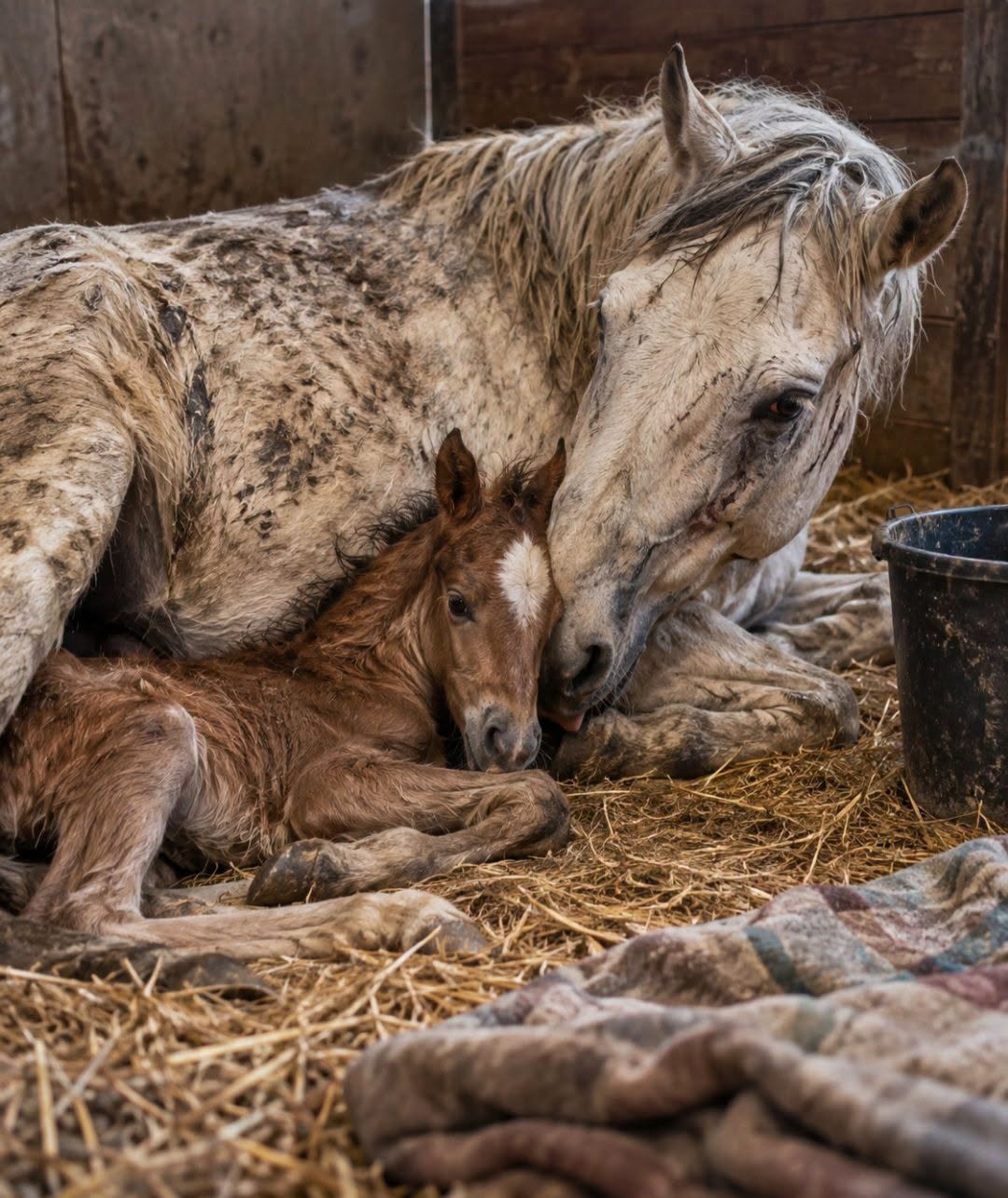
The little foal had stopped moving.
Only minutes earlier, she had been trying to push herself upright.
Now her head rested against the thick blanket beneath her.
Her eyes were half closed.
Her breathing had become so shallow that one of the volunteers had to watch the movement of her ribs just to reassure herself that the baby was still breathing.
The rescue clinic suddenly became very quiet.
The veterinarian, Dr. Harris, knelt beside the foal and placed a hand against her neck.
“Her temperature is falling.”
Nobody answered.
Across the treatment area, the gray mare lifted her head.
She was exhausted herself.
Fluids were already running through an IV line.
Her injured leg had been cleaned and bandaged.
Fresh water sat beside her.
Hay had been placed within reach.
But she wasn’t interested in any of it.
She was staring at her baby.
Dr. Harris checked the foal again.
Newborn foals were fragile under the best circumstances.
This baby had entered the world in an abandoned barn with almost nothing working in her favor.
Her mother had been malnourished.
Neither had received proper veterinary care.
The mare might have gone hours without water after giving birth.
And nobody knew whether the foal had managed to drink enough colostrum—the first milk that provides newborn animals with vital protection.
One of the rescuers, Anna, stood beside the treatment table.
She had been among the first people to enter the barn.
She had seen the mare covering the foal with her body.
She had seen the broken rope.
She had watched the tiny newborn stand for those precious three seconds.
Now she watched the veterinarian work.
“Is she going to make it?” Anna asked.
Dr. Harris didn’t give her an answer he couldn’t promise.
“She’s very weak.”
The mare made a soft sound.
The foal’s ear moved.
Everyone noticed.
Dr. Harris looked toward the mare.
“Bring them closer.”
The treatment team carefully repositioned the foal so the baby was lying directly beside her mother.
The mare immediately stretched her neck toward her.
She began licking the baby’s face.
Slowly.
Patiently.
Again and again.
The foal didn’t lift her head.
But her ear twitched once more.
The mare continued licking.
The rescuers watched something remarkable happen.
Each time the mare touched her baby, the foal seemed to become slightly more responsive.
A movement of the ear.
A tiny movement of the nose.
A weak attempt to bend one front leg.
It wasn’t enough to say she was recovering.
But she was still fighting.
Dr. Harris continued treatment while the mother remained beside her.
Warm blankets surrounded the foal.
The room temperature was raised.
Fluids were carefully administered.
Blood was taken for testing.
The team monitored her heart rate and breathing.
Minutes felt like hours.
Anna sat on the floor near the mare.
She didn’t touch her.
Not yet.
The mare had tolerated the rescuers because she had needed them, but trust was another matter.
Animals remember fear differently than people do.
Nobody knew what this mare had experienced before she was found.
The old barn told only part of the story.
There had been empty feed sacks.
A rusted bucket.
A broken gate.
The rope around the post.
No fresh bedding.
No signs of regular care.
Someone had owned her.
Someone had tied her there.
Someone had left.
Whether they intended to return or not, the result was the same.
The mare had given birth alone.
And if the rescue team had arrived one day later, Anna suspected there might have been nothing left to rescue.
The thought made her look away.
The mare lifted her head.
For a second their eyes met.
Anna spoke quietly.
“You got her this far.”
The mare blinked.
“We’ll take it from here.”
Another hour passed.
The foal remained weak.
Then Dr. Harris received the first laboratory results.
The news was mixed.
The baby was dehydrated.
Her glucose level was dangerously low.
She had not received enough nourishment.
But there were no immediate signs that her major organs had begun failing.
That mattered.
It meant they still had a chance.
The team began providing additional support.
The foal swallowed weakly.
Once.
Then again.
The mare watched everything.
When someone stood between her and the baby for too long, she shifted her head until she could see around them.
When the foal made a noise, the mare answered.
It became clear that treating one without considering the other would be impossible.
They were a pair.
Not just biologically.
Emotionally.
The mare had already demonstrated that.
Around midnight, the foal attempted to move again.
Anna saw it first.
“Her leg.”
Dr. Harris turned.
The foal was trying to fold her front legs beneath herself.
It took nearly a minute.
She stopped several times.
Rested.
Tried again.
Finally, her chest rose from the blanket.
Only slightly.
The mare immediately lifted her head.
The foal pushed harder.
Her front legs straightened.
Her hindquarters remained on the ground.
Then she slipped sideways.
Anna instinctively moved forward.
Dr. Harris raised one hand.
“Give her a second.”
The foal lay still.
Nobody breathed.
Then the baby moved her legs beneath her again.
The mare made that same low sound.
The foal responded immediately.
She pushed.
Her hind legs unfolded.
Her knees shook.
Her head swung from side to side as she tried to balance.
And then—
she was standing.
Not three seconds this time.
Five.
Six.
Seven.
The mare reached forward and touched the foal’s shoulder.
The baby leaned against her mother.
Eight.
Nine.
Ten.
Then she collapsed back into the bedding.
Anna covered her mouth as tears filled her eyes.
Dr. Harris smiled for the first time that night.
“That,” he said, “is what we wanted to see.”
The baby was still dangerously weak.
Ten seconds of standing did not mean she was safe.
But it meant she had enough strength to try.
Sometimes recovery begins with something so small that anyone else would miss it.
A swallow.
A twitch.
Ten seconds on trembling legs.
For the rescue team, those ten seconds felt enormous.
They named the foal Hope.
Not because anyone wanted to turn her story into something sentimental.
But because every time the situation seemed impossible, the tiny foal did something that gave them another reason to continue.
The mare was given a name too.
Grace.
Anna chose it after watching the exhausted horse allow strangers to care for her baby.
There was something almost extraordinary about the mare’s restraint.
She had every reason to fear people.
Still, she never attacked.
Never struck.
Never tried to injure anyone.
She simply guarded Hope.
Grace was protective without being violent.
Strong without appearing strong.
Broken in ways nobody could see, yet somehow still gentle.
Grace and Hope.
The names stayed.
During the second night, the team arranged a larger recovery stall where mother and foal could remain together.
Clean straw covered the floor.
Heat lamps were positioned safely overhead.
Grace had fresh hay.
Water was always available.
Hope received frequent monitoring.
Anna volunteered to remain nearby.
She pulled a chair outside the stall and wrapped a blanket around herself.
Around three in the morning, she woke to a strange sound.
At first she thought something was wrong.
Then she realized what she was hearing.
Hope was nursing.
Anna sat completely still.
Grace stood beside her foal.
Hope’s legs trembled every few seconds, but she remained upright.
The mare looked toward Anna.
For several moments neither moved.
Then Grace lowered her head toward the baby again.
It was the first time Anna had seen her relax while a human was so close.
She texted Dr. Harris.
HOPE IS NURSING.
His reply came almost immediately.
GOOD.
Very good.
By sunrise, word had spread among the volunteers.
People arrived quietly.
Nobody wanted to disturb them.
Through the opening of the stall, they watched the foal take several uncertain steps around her mother.
Step.
Pause.
Step.
Wobble.
Lean against Grace.
Try again.
Every movement looked difficult.
But each attempt became slightly stronger.
Grace followed her everywhere.
If Hope moved two feet away, Grace moved two feet.
If Hope lay down, Grace positioned herself beside her.
If someone entered the stall, Grace placed her head near the foal.
The old instinct to protect remained.
But now something new was happening.
Grace had started allowing the rescuers closer.
On the third morning, Anna entered with a bucket of water.
Grace looked at her.
Previously the mare would have moved her body between Anna and Hope.
This time she didn’t.
Anna placed the bucket down.
Then she stepped back.
Grace sniffed it.
She drank.
Hope was lying nearby.
Anna crouched several feet away.
“Good girl.”
Grace’s ears turned toward her voice.
Anna held out one hand.
She did not reach farther.
She waited.
Grace looked at the hand.
Then at Anna.
Then back at the foal.
Several seconds passed.
Finally, the mare stretched her neck forward.
Her nose touched Anna’s fingers.
Only for a moment.
Then she pulled away.
Anna smiled.
Trust from an animal like Grace would not arrive dramatically.
There would be no magical moment when everything bad was forgotten.
Trust would come in inches.
A hand allowed near her face.
A stall door opened without panic.
A bucket accepted from someone she once feared.
And every inch mattered.
Hope improved faster than anyone expected.
By the end of the third day, she could stand without immediately collapsing.
By the fourth, she could cross the stall.
By the fifth, she attempted her first tiny run.
It lasted perhaps two seconds.
She lifted her hind legs unexpectedly, bounced sideways, startled herself, and nearly fell into a pile of straw.
Anna laughed.
Even Dr. Harris laughed.
Grace did not.
Grace hurried toward her baby and inspected her from nose to tail.
Hope seemed completely unconcerned.
She tried again.
This time she managed three awkward bouncing steps.
The animal who had once been too weak to lift her head was discovering that her legs could carry her somewhere.
Every volunteer in the barn stopped to watch.
Hope became impossible not to love.
She was curious about everything.
Buckets.
Boots.
Jackets.
Wheelbarrows.
Straw.
Doors.
Hair.
Anything left within reach became something to investigate.
Grace remained cautious.
Hope appeared determined to investigate the entire world before breakfast.
But underneath those happy changes, Grace still had a long recovery ahead.
Her injured hind leg worried the veterinary team.
The rope had cut deeply enough to cause swelling and infection.
She was also severely underweight.
Her body had used precious reserves to carry and deliver Hope.
Producing milk demanded even more.
Dr. Harris developed a careful nutrition plan.
Too much food too quickly could create additional problems.
Recovery had to be slow.
Measured.
Patient.
Grace didn’t understand any of that.
What she understood was that food appeared every day now.
Water never disappeared.
No rope was attached to her leg.
No one shouted.
No one forced her into a corner.
No one separated her from Hope.
Still, old habits remained.
Whenever a metal latch clanged unexpectedly, Grace startled.
When a rope was carried through the barn, her entire body stiffened.
When unfamiliar men entered the aisle, she placed herself between them and Hope.
The rescue team began learning her fears.
And instead of forcing her through them, they adjusted.
Ropes were kept away whenever possible.
Movements remained slow.
New people were introduced gradually.
Nobody cornered her.
Nobody punished her fear.
The goal was not simply to make Grace physically healthy.
It was to convince her that safety could last.
That turned out to be much harder.
Two weeks after the rescue, Grace experienced her first major setback.
A storm rolled across the area after sunset.
Thunder shook the barn.
Rain struck the roof.
Most of the horses became restless.
Grace became terrified.
Anna was finishing evening chores when the first loud crack of thunder hit.
Grace spun toward the back of the stall.
Hope startled beside her.
Another crack.
Grace began pacing.
Her breathing accelerated.
Anna immediately opened the upper section of the stall door so she could see the mare clearly.
“Grace.”
The mare paced faster.
Hope tried following her.
That made the situation dangerous.
The foal was stronger now, but she was still small enough to be injured accidentally if Grace stepped on her.
Anna called for assistance.
Then lightning flashed.
For one second, the barn became white.
Grace reared.
Hope jumped backward.
Anna felt her stomach drop.
“Easy!”
Grace landed heavily.
She looked toward the wall.
Then toward the door.
Then back toward Hope.
Her eyes were wide.
Anna suddenly understood.
The storm sounded like the old barn.
The leaking roof.
The broken boards.
The confinement.
Maybe Grace had endured storms while tied to that post.
Maybe thunder itself meant being trapped.
Anna entered the stall slowly.
She knew there was risk.
But she stayed near the door.
“Grace.”
The mare looked at her.
Anna pointed toward the open aisle.
Nobody was trapping her.
The door was open.
Grace could see it.
Anna stepped backward.
Grace watched.
Another thunderclap rolled through the building.
The mare moved toward Hope.
She touched the foal.
Then she looked back toward Anna.
“Come on.”
Anna backed farther into the aisle.
Grace hesitated.
Then she followed.
Hope followed Grace.
They walked together into a larger indoor area where there was more room.
Grace immediately calmed slightly.
The walls were farther away.
Nobody blocked the exits.
Anna remained at a distance.
Within fifteen minutes Grace stopped pacing.
Hope began playing with the edge of a pile of hay.
The storm continued.
But Grace learned something important that night.
Doors could open.
Humans could open them.
And an open door did not always mean someone was trying to take her baby away.
After the storm, Grace’s trust began improving more quickly.
She allowed Anna to brush her shoulder.
Then her neck.
Eventually her back.
The first time the brush reached near the scar on her hind leg, Grace flinched violently.
Anna stopped immediately.
The next day she tried again.
A few inches farther.
Stop.
Another day.
Another inch.
Weeks passed.
The injury slowly healed.
The hair around the scar began growing back.
But the circle remained visible.
A permanent mark.
Nobody tried to hide it.
The scar was part of Grace’s history.
It did not define her.
But pretending it had never happened would not help either.
Hope, meanwhile, had become the unofficial troublemaker of the rescue center.
At six weeks old, she discovered how much fun it was to run.
Not walk.
Not wobble.
Run.
The first time volunteers released Grace and Hope into a small grassy paddock, nobody knew what to expect.
Grace stood at the gate.
She stared at the grass.
Then she stared at the open space.
The mare had spent so much time confined that even freedom appeared suspicious.
Hope had no such concerns.
She stepped through the gate.
Stopped.
Lowered her head.
Smelled the grass.
Then exploded.
Her legs shot forward.
She ran in a crooked circle around the paddock.
Her tail lifted.
Her ears pointed forward.
She kicked both hind legs into the air.
Then she raced toward Grace.
Grace jumped sideways.
Hope turned and ran again.
The volunteers burst out laughing.
“Look at her!”
Hope crossed the paddock as though she had spent her entire life preparing for that moment.
Grace stood near the gate.
Watching.
Hope completed another circle.
Then another.
Finally, she stopped several yards from her mother.
She looked at Grace.
Grace took one step into the field.
Then another.
Hope bounced toward her.
Grace sniffed the ground.
Another step.
The grass reached around her hooves.
She looked toward Anna, who stood outside the fence.
Then something changed.
Grace lowered her head.
She took a bite of grass.
Hope ran past her.
Grace lifted her head again.
And suddenly the old mare moved.
Not quickly.
Not gracefully.
But she trotted.
Only several steps.
Hope immediately turned.
The foal ran beside her mother.
For perhaps five seconds, Grace and Hope moved together through the field.
Nobody spoke.
Anna felt tears on her face before she realized she was crying.
Weeks earlier, Grace had been lying in a filthy stall, too weak to stand, using her own body as a shield.
Now the same mare was moving across green grass with her foal running beside her.
Grace stopped.
Hope continued.
Then Hope turned back and returned to her mother.
As always.
Over the next several months, their lives settled into a routine.
Morning feed.
Health checks.
Paddock time.
Training.
Rest.
Grace gained weight steadily.
The sharp outline of her ribs softened.
Her coat changed from dull gray to silver.
Her mane grew out.
The swelling in her hind leg disappeared.
She began interacting with other horses across the fence.
At first she kept Hope away from them.
Eventually she allowed calm mares to approach.
Hope loved everyone.
Horses.
Humans.
Wheelbarrows.
Probably birds if they stayed still long enough.
The rescue center began sharing occasional updates with supporters.
Pictures of Grace eating.
Videos of Hope running.
A photo of mother and foal sleeping in the sun.
People became invested in their recovery.
Donations arrived for veterinary bills.
Someone sent blankets.
Someone else donated feed.
A local farm supplied hay.
Children mailed drawings.
One drawing showed a large gray horse standing over a tiny brown foal beneath a giant yellow sun.
At the bottom a child had written:
“Moms are strong.”
Anna taped it outside the stall.
The story brought something else too.
Information.
Three months after Grace and Hope were rescued, a woman contacted the rescue center.
She believed she recognized Grace.
The woman’s name was Margaret.
Years earlier, she had owned a gray mare named Willow.
Willow had been gentle.
Patient.
Good around children.
Margaret had sold her after a family financial crisis forced her to reduce the number of horses she owned.
She had believed Willow was going to a safe home.
Later, she lost contact with the buyer.
When Margaret saw Grace’s photographs, something about the small white marking above her left eye caught her attention.
She sent old pictures.
Anna opened the first one.
A healthy young gray mare stood beside a wooden fence.
Same eyes.
Same marking.
Same shape around the face.
Dr. Harris compared records where possible.
A microchip eventually confirmed it.
Grace had once been Willow.
The discovery brought mixed emotions.
It proved that Grace had not always lived the way they found her.
She had known kindness.
She had known open fields.
She had once been healthy.
But somewhere between then and the abandoned barn, everything had changed.
Margaret came to visit.
Anna wasn’t sure how Grace would react.
They stood outside the paddock while Grace grazed beside Hope.
Margaret began crying before she even reached the fence.
“Willow.”
Grace lifted her head.
Her ears turned forward.
Margaret covered her mouth.
“It’s me.”
For several seconds Grace did nothing.
Then she began walking toward the fence.
Slowly.
Hope followed.
Margaret placed one trembling hand against the wooden rail.
Grace came closer.
She sniffed the air.
Then she touched her nose to Margaret’s hand.
Margaret broke down.
“I’m sorry.”
Grace remained there.
Margaret stroked her face.
“I’m so sorry.”
Nobody interrupted.
There are some things animals cannot understand in human words.
Grace could not know why Margaret had sold her.
She could not know about money or contracts or promises made years earlier.
But perhaps she remembered the voice.
Or the smell.
Or simply the feeling of a hand that had once been kind.
For several minutes she stood quietly.
Hope pushed her nose between them.
Margaret laughed through her tears.
“And this must be your baby.”
Hope immediately tried chewing Margaret’s sleeve.
Everyone laughed.
It was exactly the kind of interruption they needed.
Margaret did not ask to take Grace back.
She understood that too much had changed.
Instead, she began visiting occasionally.
She brought carrots.
She helped with grooming.
And each time Grace saw her, the mare walked toward the fence.
The rescue center eventually began discussing permanent placement.
Grace and Hope could not remain there forever.
The goal of rescue was not simply survival.
It was a future.
Finding the correct home would be difficult.
They wanted the pair adopted together.
Grace needed experienced handlers.
Hope needed space to grow.
Neither could be placed somewhere that viewed them as decorations.
Several applications were rejected.
Then a family named the Parkers applied.
They owned a quiet thirty-acre property approximately an hour away.
They had two older horses.
A large barn.
Several paddocks.
And years of experience caring for rescues.
More importantly, they were willing to adopt Grace and Hope together.
Anna visited the property.
The fences were safe.
The stalls were large.
Grass covered the fields.
There was shade.
Fresh water.
Everything Grace had been denied before.
Still, Anna worried.
She had become deeply attached to both horses.
Letting them leave felt almost impossible.
On adoption day, she stood beside the trailer while Grace hesitated at the ramp.
Months earlier, Grace had entered another trailer barely able to stand.
Now she was healthy.
Alert.
Strong.
Hope walked up the ramp first.
Of course she did.
Hope would probably have walked into someone’s kitchen if the door was open.
Grace watched her daughter.
Then she looked at Anna.
Anna placed her hand against Grace’s neck.
“You’re okay.”
Grace remained still.
“You’re going somewhere good.”
The mare stepped forward.
One hoof onto the ramp.
Pause.
Another.
She stopped halfway.
Hope called from inside.
Grace continued.
The trailer door closed.
Anna cried after they drove away.
Not because the story was ending badly.
Because it was ending the way rescue stories are supposed to end.
With empty stalls.
An empty stall means someone went home.
The Parkers sent updates almost every day during the first week.
Day one:
Grace and Hope explored the paddock.
Day two:
Hope attempted to steal a grooming brush.
Day three:
Grace met one of the older geldings through the fence.
Day four:
Hope discovered mud.
The photograph from day four showed the once-brown foal almost completely covered in black mud.
Anna laughed for several minutes.
Six months later, she visited them.
Hope had grown dramatically.
Her legs were longer.
Her chest was stronger.
The fragile newborn they had once carried from the barn had become a confident young horse.
She recognized Anna immediately.
Or at least she recognized Anna’s pockets.
Hope pushed her nose against Anna’s jacket looking for treats.
“You haven’t changed at all,” Anna said.
Grace stood farther away.
Healthy.
Shining.
Peaceful.
Anna walked toward her.
Grace lifted her head.
Then she came forward.
No hesitation.
Anna touched the mare’s face.
Grace closed her eyes.
Behind them, Hope suddenly ran across the pasture.
Grace lifted her head.
For a fraction of a second, Anna remembered the first day.
Grace lying against rotten straw.
Her face across the baby’s neck.
Her exhausted eyes following every human movement.
Protecting.
Guarding.
Refusing to leave.
Now Hope was hundreds of feet away.
Running.
Grace watched her.
But she did not panic.
She did not chase.
She did not place her body between Hope and the world.
She simply watched.
Hope ran to the far fence.
Turned.
And came racing back.
Her mane flew behind her.
Her hooves struck the earth.
She slowed as she reached Grace.
Mother and daughter touched noses.
Then Hope wandered toward the grass.
Anna smiled.
That might have been the biggest sign of Grace’s recovery.
She had spent so long believing that if she stopped protecting her baby for even a second, something terrible would happen.
Now she had learned something different.
Hope was safe.
Grace was safe.
She didn’t have to guard every moment anymore.
Several years later, the scar from the rope could still be seen on Grace’s hind leg.
Hope grew into a beautiful mare.
The two remained together.
Visitors who heard their story sometimes asked the same question.
“How did Grace survive that barn?”
There was no simple answer.
Veterinary care saved her.
The rescue team saved her.
Food, water, medicine, and shelter saved her.
But anyone who had seen her that first day believed something else mattered too.
Grace had something beside her worth standing up for.
When her own strength was almost gone, she used what remained to reach her baby.
She broke the rope.
She crossed the stall.
She placed herself around Hope.
She refused water until her foal was beside her.
She stayed awake when every part of her body was begging her to rest.
Maybe Grace survived because Hope needed her.
And in the weeks that followed, perhaps Hope survived because Grace never stopped reminding her to fight.
The rescue team had entered that barn believing they were about to save one abandoned horse.
Instead, they discovered two lives wrapped around each other.
A mother who refused to leave.
A newborn who refused to stop trying.
And a bond stronger than fear, hunger, injury, or neglect.
The most powerful moment wasn’t the day Hope first stood.
It wasn’t the day Grace finally allowed Anna to touch her.
It wasn’t even the first time mother and daughter ran together through the paddock.
It happened much later.
On a warm afternoon at the Parker farm.
Grace was grazing beneath a tree.
Hope was sleeping several yards away in the sunshine.
No walls surrounded them.
No rope held Grace’s leg.
No humans stood between them.
No danger was coming.
Grace looked toward her daughter once.
Then she lowered her head again.
And kept eating.
For anyone else, it would have looked completely ordinary.
But Anna understood what she was seeing.
For the first time in perhaps years, Grace was no longer surviving.
She was simply living.
And the tiny life she once protected with the last of her strength was now strong enough to run across an open field all by herself.
Hope eventually woke.
She stretched her long legs.
Then she stood.
Grace looked up.
Hope walked toward her mother.
The two touched noses.
And together, under a sky far larger than the roof of the barn where they had nearly died, they slowly walked toward the far end of the pasture.
No ropes.
No fear.
No one left behind.
Just a mother and her baby.
Finally safe.
Finally free.
And finally home.
